A course on contacting the intelligence of the body,
April 10-12 in Frome, Somerset
This workshop will show methods of contacting and communicating with the intelligences of the body.
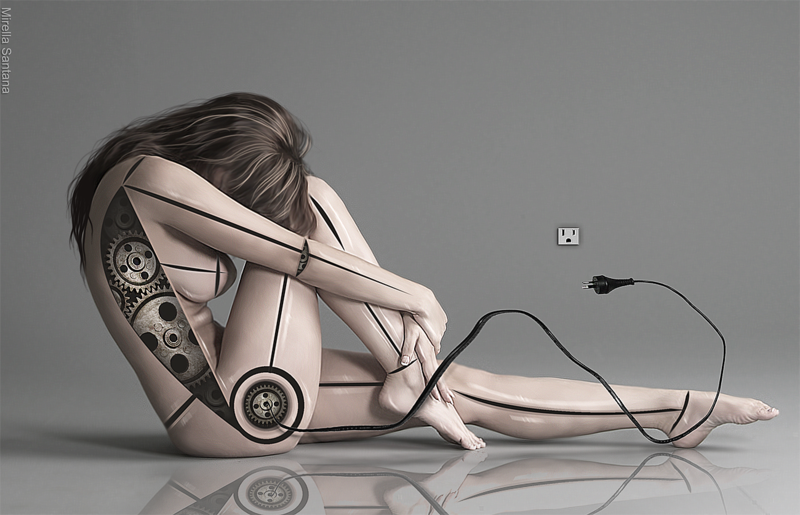
When something goes wrong in the body, we often go to a physical therapist to try to ‘fix’ it. But the idea of fixing the body comes from the mind having an ideal idea of how we should be. The body is seen as a biological machine, controlled by the mind.
The idea of the Inner Community sees every part of the body as being a ‘person’, with feelings and intelligence. Instead of trying to fix a part that is ‘not working’, it is often more effective to ask that part what support it needs from the rest of the organism. Then the rest of the inner community can adjust to take care of that part and fully include it.
But these body-people don’t speak in words. Their language is movement , sensation and sound.
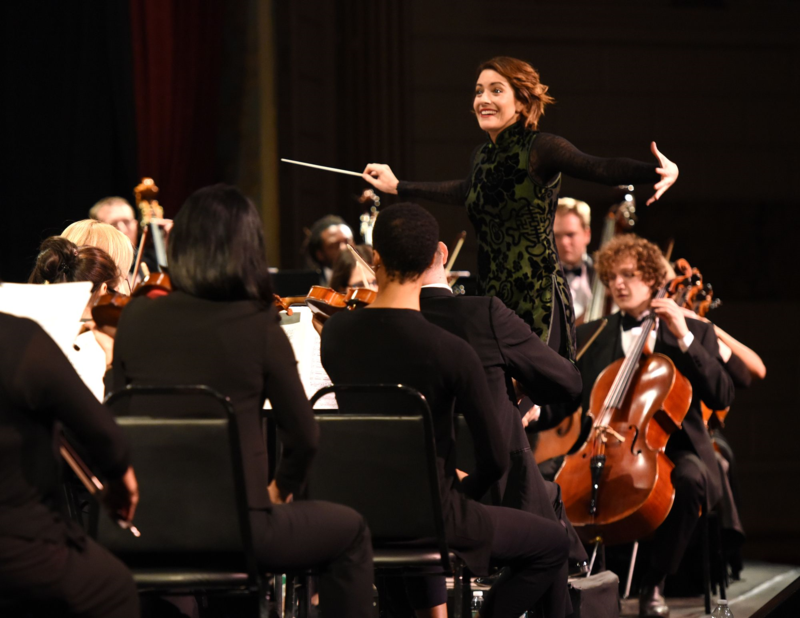
The workshop will demonstrate how to communicate with these body-people at several levels. You can talk to individual muscles and organs. You can explore the character of different systems and your will learn to contact particular members of the community that are ‘group facilitators’. We will show how these inner facilitators are preceisely the forms of Qi described by East Asian medicine. So the Qi-functions are the conductors of our inner orchestras.
This transforms Qi-therapies. Instead of trying to fix a person, therapy becomes a process of opening a conversation with the Qi. Helping a person to listen to their inner intelligences and to let go of the mind’s tendency to judge and control the body.
This workshop is very practical and focused on experience rather than theory. You don’t need to be a therapist. You can use it as a framework for profound self-exploration. If you are a body-based therapist, we will demonstrate techniques for helping clients to contact their body. If you are a Shiatsu practitioner, we will show how to use movement and imagination to guide a client to converse with their own Qi-functions.
During the workshop we will explore:
Different qualities of touch and how they bring specific tissues and systems into awareness
Archetypal movement patterns and their relationship to meridian energy
Drama-based processes that allow body parts and inner aspects to “speak” in the first person
Voicework and breathwork to soften habitual patterns and support authentic expression
This article explores how the Self can be viewed as a community of sub-personalities – distinct and relatively autonomous parts of a person that emerge in response to specific psychological situations or contexts. The way in which these parts of the self are used in psychotherapy often overlooks the role that the body plays in our psyche. We will show how the Qi functions of East Asian medicine can be experienced as body-based subpersonalities and how treating these functions as ‘internal people’ transforms Shiatsu therapy.
The Narrative Self Imagine you are on a date. As you get to know each other, you both naturally share stories from your past — moments that shaped you, things you love or dislike, and your hopes for the future. Through this exchange, you each begin to build mental models of the other: internal representations that help you predict how the other person might act or respond in different situations. In fact, you already use a similar model of yourself.
Several psychologists and philosophers call this the Narrative Self since it emerges from an edited version of our history. The key word here is ‘edited’. If your date turns into a long-term relationship, your partner will notice that what you actually do and the things you really like are often quite different from your narrative. It’s not as simple as saying that you show your best sides in your anecdotes, you can be completely honest but also hold a mistaken model of yourself.
Iain McGilchrist[i], along with other psychologists and neurologists, has shown that the narrative self is primarily rooted in the left hemisphere of the brain. This hemisphere specialises in constructing models based on past patterns of behaviour and personal preferences. It is also the region responsible for language — so when we talk about ourselves, it is this part of the brain that is doing the talking.
Our narrative self is shaped not only by personal experience but also by the cultural environment around us. As teenagers, for example, we often seek an identity that distinguishes us from our parents. We’re frequently drawn to a group — perhaps initially because we admire someone within it — and we begin to adopt the tastes and values of that “tribe”: their music, clothing, politics, and so on. This is a natural part of adolescence and of forming an adult identity.
However, in modern society, we often fail to balance this socially constructed self with what we might call our individual spirit — the deeper, intuitive sense of who we are beyond group identity. And it is here, I believe, that many of our psychological and physical difficulties begin.
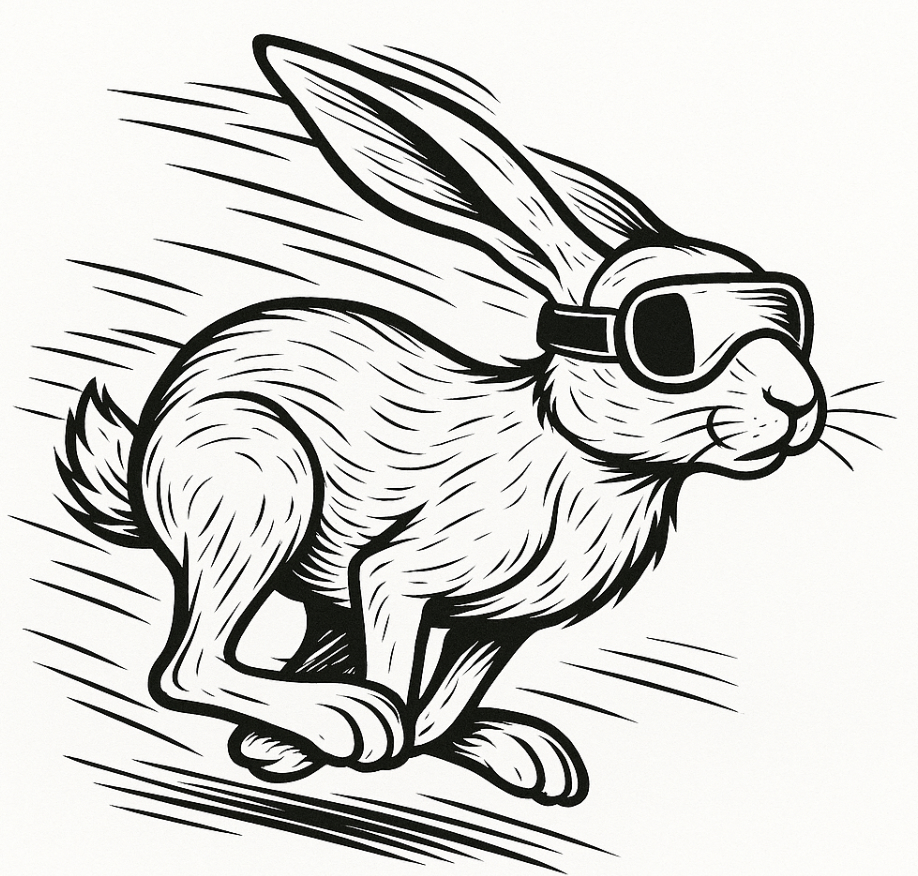
The strength of the narrative self lies in its speed. When faced with a new situation, it quickly categorises it as similar to a story it already knows. It skips over the unfamiliar, smoothing out nuance, so it can draw quickly on past experience to predict, analyse, and judge. Guy Claxton[ii] calls it the Hare Mind — nimble, clever, and fast.
But this quickness blinds it. It misses the whole picture, the shimmering edge of the unknown that might change everything. It sees the present through the tinted lens of the past and calls it understanding.
Worse still, many of its stories are borrowed — hand-me-downs from parents, peers, media, and culture. These tales may carry the weight of collective wisdom, but they were not written for your life. They are second-hand maps, and they do not always lead you home.
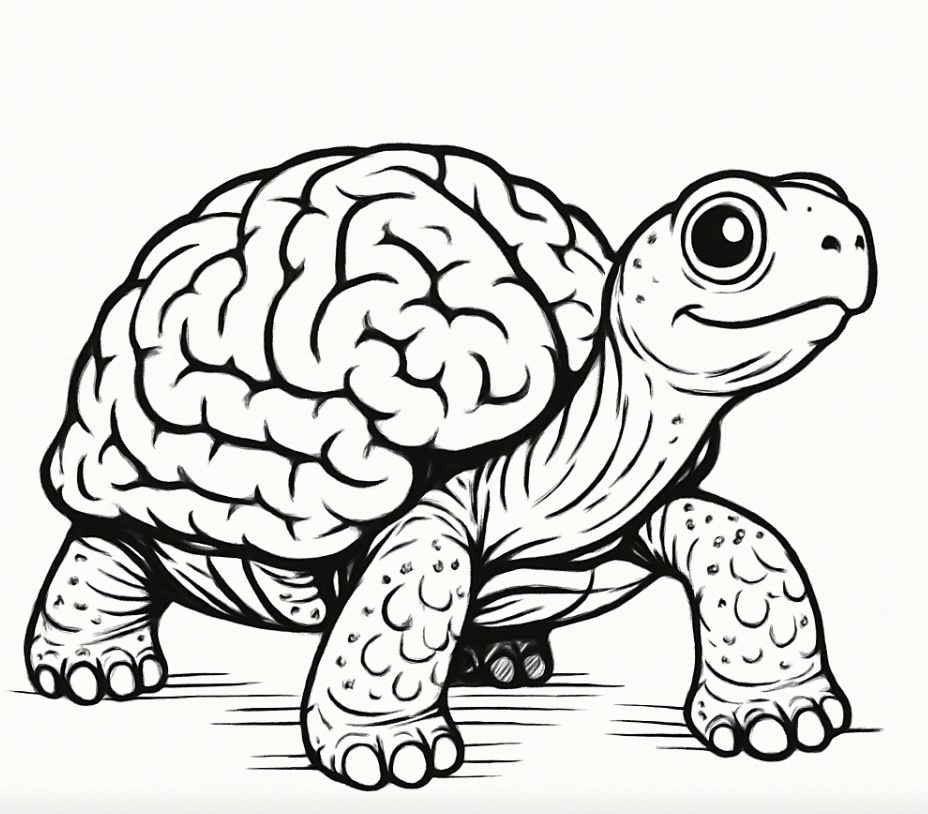
Claxton identifies another type of thinking he calls the Tortoise Mind. It is more playful, without straightforward aims. It ruminates and dreams and gives space for the situation to unfold and reveal its newness. It takes in the complexity of the present, sees how you, personally are part of the situation and allows your individuality to assert itself so you are not over-conditioned by other people’s views.
Yet this part of us cannot speak in words — and so, in the noise of everyday life, it is often drowned out. But when we offer it space and stillness, it begins to speak in its own language: through bodily sensations, spontaneous movement, and non-verbal sound.
Iain McGilchrist links it to the right hemisphere of the brain, but I see that hemisphere more as a receiver — tuned to deeper, body-based intelligences. Some of this wisdom, I believe, does not originate in the brain at all, but arises from other living systems within the organism — a chorus of intelligence spread throughout the body.
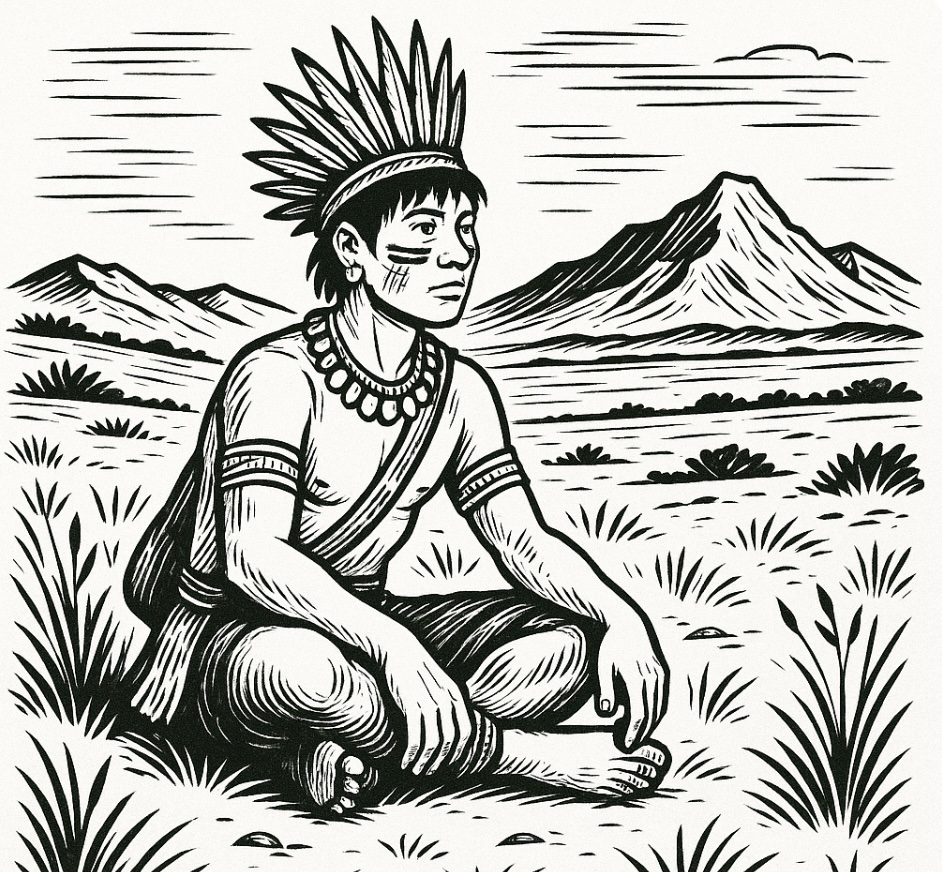
It’s time for you to die! Several years ago I watched a documentary about an Amazonian tribe. A thirteen year old boy was playing in the river when an elder approached him and said “It’s time for you to die!”. No one was shocked, for them it was a normal part of growing up. What he meant was that it was time for the child to die and the adult to start to form. From that moment the boy spent most of his time in a Men’s Circle learning how to be a man. So far this is similar to our adolescent development, except that his adult-circle was chosen by the elder, while we choose our own gang. The difference came a bit later when the young man went alone to fend for himself in the wild, separated from the tribe and his group. This “alone-time”, with the help of rituals and structure, put him in touch with his individual spirit so he could feel his core purpose and knew what role he had to play in the tribe. When he returned, they recognised this insight and gave him a role that harmonised with his spirit.
Quiet, solitary time creates a space where deeper parts of ourselves — those beyond the reach of the narrative self — can begin to emerge. The narrative part of us is outward-facing, shaped by imitation and social expectation. It is also backward-looking, stitched together from past experiences and remembered stories. Because of this, it often leads us to act in ways that aren’t truly aligned with who we are in the present. When the truth of the body is overridden, this inner conflict can show up as resistance, injury, or exhaustion — the cost of living by a story that isn’t fully our own.
Beyond these verbal parts are deeper intelligences that safeguard our spirit and body. Of course, the narrative self includes concepts of the body but, in the main, these are ideas of how the body looks to others, it’s prowess or lack of ability, and its ability to carry out the wishes of the mind. In modern culture, the body is often seen as a tool for fulfilling mental agendas. For instance, many men are conditioned to live within a story that expresses their strength and endurance. This can lead them to ignore complaints from the body. Then they injure themselves. Many of my male clients have expressed impatience with and even hatred of a painful part of their body – wanting me to fix it quickly so they can go back to using it as normal.
I prefer to help them to view pain as the body speaking. It’s asking them to find another way of moving or behaving. I teach them how to listen to the language of the body, not using words or images but noticing particular sensations and movements. Alongside this, we play with different ways of using the painful part, crucially not imposing a ‘correct’ way but listening to the body until it indicates which movement it prefers.
One of the reasons these inner people are ignored is that they don’t speak in words. Even if we learn to understand their communication through movement and sound, the modern world still doesn’t give them time or space. They need alone-time and a slower pace to take in the whole picture, digest it and respond. They make up Claxton’s tortoise mind, so we can call them the Tortoise People.
The tortoise people are the sub-personalities of the body. They align more with Iain McGilchrist’s description of the right hemisphere of the brain:
Perceiving thewhole organism, not just parts or abstractions.
Seeing things in context and in relation to each other.
Emphasizing connection over control, and relationships over manipulation.
They are the source of imagination, insight, metaphor, and creativity.
We can see from this list that these capacities complement the functions of the narrative hare-people. Without the tortoise-people, we tend to objectify the world, only seeing its parts without grasping the whole. As McGilchrist points out, much of the trouble in the world comes from the fact that the narrative self has taken over leadership of the internal community and ignores the whole-picture wisdom of these body-based entities. I think that the way we treat our body is very similar to the way we treat our planet. So if we can learn to incorporate and listen to the tortoise-people, maybe we will also learn to listen to our non-human environment.
Listening to the Tortoise People
Most people are familiar with the sense of gut feeling so this is a good place to start listening to the body. For instance, I embark on a course of action but I get a tight, achy feeling in my gut, my breath stops and I lose energy. I know in a profound way that I am making a mistake. The body uses gut feelings, pain and other forms of discomfort to protest against decisions made by the narrative self. But we often ignores the message. By taking the body-people seriously when they complain, we tell them that we are listening and then they start to help us in more positive ways, giving us guidance even when nothing is wrong.
Society constantly pressures us to behave in ways that may not arise from our true nature. Over time, we often internalise these expectations, folding them into our narrative self, where they take the form of inner commands: “I shouldn’t show weakness,” or “I must always be kind.” These swallowed pressures are called introjects and someare easy to adopt — even helpful. But others are so alien to our nature that we need to say “NO!”, otherwise our spirit is crushed.
We need a way to discern which pressures we can authentically integrate, and which ones we must refuse — not out of defiance, but out of fidelity to who we are. Without that inner discernment, we risk losing contact with our deeper self and living a life shaped by empty rewards and hollow purpose.
The first step is to re-externalise our introjects. This means that when we catch ourselves saying “I should…” or “I must not …”, that we reframe the demand as coming from an external source. Maybe we remember who gave us a particular inhibition, so we can say, for instance: “My father tells me to be quiet” or maybe, more generally, we can just say “Society tells me I should not do this”. Then it is easier to ask “Is this demand something I can take on without harming my spirit?”
One of the tortoise-people, which we can call The Discriminator, is the part of us that can answer this question. In Chinese medicine, it is called the Small Intestine because that organ in our body selectively detects those parts of our food that we can assimilate and those that are not needed or even toxic. The Qi-function is much wider and not limited to food. Cultural pressure can also be seen as energy that is being taken in, analogous to food. So the Discriminator can tell us which pressures to accept or resist.
The Space Keeper is the person who actually knows how to say “No” and pushes away toxic energy when detected by the Discriminator. He also helps us let go of patterns of behaviour that are harming us. He frees us and gives us space to be ourselves. Practitioners of East Asian therapies may recognise this being as the Qi of the Large Intestine.
Another important figure in the Inner Community is The Shaman. She is the mouthpiece of the spirit and the channel for spontaneity and creativity. This part of the self is hard to sense while we are embedded in society, so needs regular and extended periods of alone-time to be heard. But when the narrative self is quietened, as in meditation or rumination, insights and messages from the deepest layers of the self bubble up spontaneously. In the language of Chinese medicine, this is the Shao Yin, channelling the primal Kidney energy into the awareness of the Heart.
Seeing these functions as people rather than the rather abstract idea of meridian Qi changes the process of therapy dramatically. For instance, therapies like Shiatsu and Acupuncture traditionally start with a process of diagnosis. Essentially, a diagnosis is a story and so is in the domain of the narrative self. It is a way that the left brain can make sense of the state of the body-people so that we can know what to do. Although diagnosis and treatment can be intuitive, the way they are performed is often in the manner of the left-brain: categorising the person and working out how to change their state. The client is relatively passive in this process because it does not give them the opportunity to hear the wisdom of the body-people for themselves.
Alternatively, one can approach the therapy without an agenda or a diagnosis, teaching clients to be aware of sensations and impulses to move. This is playful and gives them a sense of empowerment. Working with movement enables the body-people to say what they need in order to do their jobs well and this naturally leads into focused bodywork. That is one of the reasons I like to use personal names for them rather than the traditional Chinese terms because it helps us to have conversations with them. By personalising the Qi-functions and recognising their action in daily life, we learn to know them as friendly guides rather than mysterious energies.
Learning to listen to the body Most psychological theories include a dominant, Ego-self; owning the main ‘published narrative’ who acts as a central arbiter. If impulses come from other personalities, the Ego-self judges whether they fit into its self-image and represses or ignores them if not. In other words, the Ego-self gives leadership to the inner community, often as a dictator.
In my youth, I couldn’t sense an Ego-self. I was an unruly, non-organised group, continually getting into trouble. I desperately needed a part of me to act as a benevolent facilitator of my inner group.
In 1979 I met the work of Keith Johnstone[iii], who was a ground breaking theatre director exploring the process of improvisation. In his workshops, he used masks, posture, voice and movement to help actors become different characters. This was beautiful work which helped me articulate and express some of the shadowy parts of my narrative self. But it still did not give me a way of coordinating my inner group.
However, I discovered that I could adapt Johnstone’s techniques to bring the body-people into awareness. Rather than using masks, I developed a practice of body-scanning, tuning in to subtle sensations I would usually overlook. From there, I would choose one sensation and allow the rest of the body to embody its character — shaping posture, movement, and presence to reflect it.
In this way, the sensation became a gateway, bringing a distinct body-person to the foreground. Strikingly, these figures did not speak, and they had no narrative — yet they were profoundly expressive. Through this process, I found that different organs and structures in the body could speak for themselves, not in words, but through movement, posture, and feeling. It has since become a central thread in my work.
While narrative selves often focus on fitting into someone else’s story, the internal organs are indifferent to the opinions of others. I found that they tended to have a clearer sense of what I could handle, what I truly needed, and what was harmful. This awareness led me to a new way of making decisions: I gave my body a veto on my choices, providing a grounded perspective that helped me resist being seduced by external influences when they would harm me.
I feel now that the two groups of sub-personalities: Hare People and Tortoise People, Narrative Selves and Body Selves need each other. I believe that the future of humanity will be determined by whether the narrative self can recognise its limitations and see the whole-picture viewpoint of the tortoise-people. Giving the latter the power of veto turns out to be the key to balancing the Inner Community and developing the capacities that humanity is desperately needing: kindness, tolerance and the ability to resist societal pressures that would kill the spirit. So body therapies could contribute to a vital change in society if therapists can let go of the medical model of trying to fix the body and focus on showing people how to listen to it.
Bill Palmer and Teresa Hadland are running a five day residential course exploring this theme in the autumn see https://seed.org/residential-2025 for more details.
[i] Iain McGilchrist: The Master and his Emissary (2009)
[ii] Guy Claxton: Hare Brain, Tortoise Mind (1998)
It is part of human nature to want things to be better. We imagine what could be and then we search for a way of manifesting that vision. All living beings seek for solutions to their problems; Roberto Kolter has even documented the intelligence of bacteria and slime moulds in collectively overcoming obstacles to find food[1]. But our species takes this capacity to another level through invention for its own sake. This drive to improve everything and solve imaginary problems is both the source of our amazing success in dominating the planet but could also be the seed of our potential extinction.
The negative side of this impulse is that we imagine that any discomfort should be fixable. This gives marketing, religion and politics a hook with which to catch us and control our behaviour. They highlight imperfections and claim that our lives could be improved if we bought their products, believed in their dogma or voted for their party.
But the cost to humanity is that we can easily develop an addiction to their quick fixes and become continually dissatisfied. This insatiable state leads to super-consumerism, perpetually acquiring things that we don’t need, if we can afford it, and yearning after those things if we can’t. In the process we swarm over the planet like locusts, stripping its resources and driving other beings to extinction. As a species, we have a tendency to manifest the state of being that Buddhism calls the Hungry Ghosts[2].
However, this black picture is not the whole story. We also have an enormous capacity for love, for awareness and compassion. My aim in this article is to explore how the act of doing therapy often contributes and amplifies the Hungry Ghost state and to consider how to change the form of the therapy so that it supports our capacity for conscious responsibility.
Liberation is different from Cure
Liberation from dissatisfaction is different from fixing its imagined cause. Picture a bag made from a substance that easily tears. Imagine that it is overfilled with water so that the strain tears the membrane and water starts to spurt out. There are two obvious ways to fix this problem. The first, which we might identify with western medicine, is to put a sticking plaster on the hole – but then the pressure of the water tends to split the skin in another place. The second, which is more related to East Asian medicine, is to strengthen the material from which the bag is made. But, in the limited context of therapy, one can only identify a local weakness and strengthen that place; this actually creates more stress on other areas so new holes appear.
The real issue is the pressure of the water, which in my analogy I am equating with the pressure of dissatisfaction. If one could decrease this stress, then the bag, without change, could hold firm without plasters or reinforcement. In modern culture, social pressure tends to drive people to want to be different from how they are and it is this desire for improvement beyond the limits of their nature that inflicts damage on the fabric of their being.
Many therapies, including Shiatsu and Chinese Medicine, focus on strengthening the weaknesses in the fabric. This is more sustainable than just patching the holes but, because the practitioner is the active partner while the client is relatively passive, the form of the therapy still perpetuates the underlying issue: people are still looking to experts to fix their problems. It is true that these therapists do suggest exercises for the client to do at home but these routines are prescriptions rather than explorations. So, although the client is active, they are not in charge of their activity: they are still dependent on the therapist to tell them what to do.
This active-expert, passive-client dynamic is less common in psychotherapy because it depends on the client exploring themselves and gaining understanding through introspection. Physical therapies tend to be more prescriptive simply because the internal workings of the body are less accessible to consciousness. Energy therapies like Shiatsu are even more inaccessible to the client because most therapists don’t teach the client how to sense their own Qi, but perform a mysterious diagnosis and equally obscure treatment. The client has no choice to be other than passive in this dynamic.
So there are essentially three ways of doing therapy: treating the symptoms (putting sticking plaster on a hole), activating the body’s self-support systems (strengthening the fabric) and, thirdly, helping the client to actively explore themselves using their problems as valuable sources of information rather than trying to get rid of them (reducing the pressure of dissatisfaction). Both East Asian and Western Medicine focus on the first two but, in the modern world, the third option is overlooked and even disregarded.
This is a shame because the third way is particularly appropriate for people with chronic issues. They have often tried an assortment of therapies without success and are looking for a different type of approach that helps them to live harmoniously with their condition rather than trying another way of curing it. I also think that the third way supports the spiritual development of the human species while the first two paradigms tend to perpetuate the state of dissatisfaction. So how can we work in this third mode?
Life as a Course I have a fantasy. It doesn’t matter whether it is true or not. It gives a new perspective on life. I dream that, before I was born, I went to the University of Life and looked at the courses on offer. One, in particular, appealed to me and I applied to enrol. The administrator told me that I was qualified to take this course and that they would give me these parents, this body, particular relationships and the problems and diseases that went with them all. This life is my course!
From this viewpoint, problems are transformed from obstacles into lessons. There is no point in curing or fixing my issues if the process doesn’t fit with the ‘course-plan’ I was given at conception.
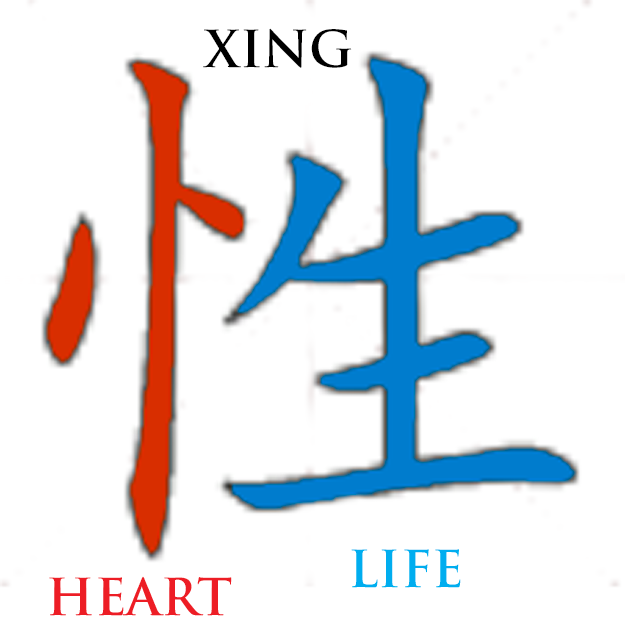
This fantasy is an expression of the Taoist system of Internal Alchemy (內丹 – Nei Dan). This system focuses on the development of Xing (性) and Ming (命). The most superficial translation of these profound concepts is that Xing is our innate nature or character and Ming is our pre-ordained Destiny. In the medieval Taoist world-view, these are given by the gods and can only be changed by divine intervention. The old medical texts[3],[4] suggest that working with the Qi will not be effective unless you take both Xing and Ming into account. In this level of meaning, the Xing is like a landscape with valleys and hills. One’s life flows through the valleys; diseases and problems are seen as blockages to this flow. Working with Qi can clear the ‘debris’ that is blocking a valley but cannot change the basic landscape of the person that pre-disposes their strengths and vulnerabilities. This means that the attempt to alter certain basic Qi patterns is doomed to failure, so a diagnosis of the person’s Qi may not lead to an effective treatment.
A deeper meaning to the words interprets Xing as the direction to which one’s heart is drawn. In fact, the character for Xing combines Heart and Life. The Ming is seen as the path through life created by this direction and has the meaning of a calling or vocation[5]. My fantasy about the University of Life fits with this interpretation and it is this meaning that I find most useful in working with clients who are struggling with chronic conditions or the problems of youth and old age.
When you are young, particularly in the teenage years, friends, media and parents pressure you to fit in with their world-view, which may conflict with your nature. Unless you can sense your Xing you can easily get lost without a sense of direction in life. The brain and its ability to think are not good guides to the Xing because they evolved to develop social relationships and to learn from culture. In contrast, the body is not concerned with other people and, by learning to listen to its subtle messages, you can sense the Xing. Essentially, if you are following your Xing then you feel fully alive in your body.
People with chronic conditions frequently spend an enormous amount of energy trying to find a cure which often doesn’t exist. But this means that they never meet the challenge of the condition and the lessons they can learn from it. On the other hand, if they embrace and value the issue then the difficulty can temper the soul and strengthen the spirit. A client with a brain tumour taught me how to work with the Xing. She had been told by her doctor that she probably only had a few months to live but the disease had kicked her into a state of aliveness she had never before experienced. She came to see me, not to try to cure the cancer but to “help her to stay fully alive for as long as she had left”.
Her main challenge was her fear which negated her feeling of aliveness. I first asked her to sense which parts of the body contracted in response to the fear. We explored how she could breathe into the organs which inflated that part of the body from inside, causing an authentic expansion. She soon learned to sense where she felt pain or fear and to use this breathing technique to expand rather than contract, so that she faced the difficulties of her condition with an open, positive posture. As a side effect of this, she reported that her friends stopped treating her as ill. In only a few sessions she found she could do without my support and I only saw her every two months or so. In the end she lived for another nine years, following her heart and seizing every opportunity for living to the full.
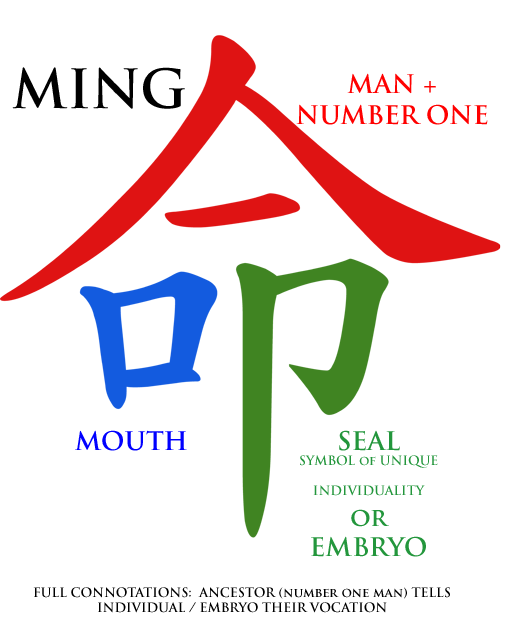
If you can reframe your problems as opportunities for development then you can look back at what you have learned and see the strengths and abilities that your condition has given you. If you learn to feel when you are on your heart-path, and meet any obstacles as lessons to be learned, then you gain a sense of life-purpose, which is the deeper meaning of Ming. This is shown in the Chinese character, which has the connotation of telling, calling or instructing an embryo what to do in its future life.
Whereas Xing can be sensed at any stage of life by noticing what makes you feel alive, Ming is usually not understood until later, when you look back and see the patterns that you have made with your life. Erik Eriksson characterized human development as a series of challenges that teach a capacity[6] and described the consequence of not learning that lesson. The challenge of old age is to embrace all the events of your life equally and thus make sense of your existence. Eriksson named this state ego-integration. Reframing your past behaviour and your present pains as lessons in the classroom of life is a good way of integrating the self. Old age is difficult because, inevitably, the body starts to deteriorate and, looking back on your life, there are often many things that you regret. If you can’t let go of your regrets and continue to yearn after your youthful abilities then the result, according to Eriksson, is despair.
But it’s difficult to let go of regrets. They refer to events that are past and can’t be changed. But you can reframe your view of them to have compassion for yourself. I find this self-compassion is easier to learn through the body and a good example is how you relate to your tense muscles. You can either treat them as a problem, trying to stretch them, complaining about them, getting massage to try to relax them. Alternatively, you could value them and praise them for their positive function.
One purpose of chronic muscle tension is protection; holding a vulnerable part of the body from moving. You can value this even if the protection is not needed any more. In this case you can consciously condense the muscle further rather than trying to loosen it. Unlike muscle release techniques like Sotai, this is not done as a way of tricking the muscle to relax, but as a way of saying to the muscle that you are going with it and valuing its past positive function. Once you learn this attitude to physical problems, you can more easily apply it to all those parts of yourself that you deplore so that you can value them as lessons which are part of your life-course. At this level, developing Xing and Ming resolves the state of dissatisfaction. They give meaning to life and reduce the pressure of the water in the bag we pictured before.
Everything is the Play of the Dharmakaya
There is an even deeper meaning to the words Xing and Ming that is almost impossible to describe in words. It underlies the philosophy and practice of Dzogchen (Tibetan for “Great Perfection”), which I studied with Chögyal Namkhai Norbu for many years. I only glimpse this deeper meaning, and what follows is my very limited understanding, but it comes from experience and not from received words.
Several physicists[7] and philosophers[8] suggest that consciousness is a fundamental part of the fabric of reality rather than a rare phenomenon that emerges from the complexity of a brain. Donald Hoffmann[9], in his book The Case Against Reality, describes experimental evidence that material reality is a construction of consciousness rather than something that consciousness passively perceives. He therefore suggests that instead of trying to understand how consciousness can emerge from matter, we see consciousness as fundamental. This does not mean, as the panpsychists believe, that everything is aware. Instead, he proposes that underlying reality is made of consciousness and that material things are perceptions created by this consciousness as a way of making sense of existence from a dualistic viewpoint. This is very similar to the view of reality held by the mystical branches of Buddhism and Taoism.
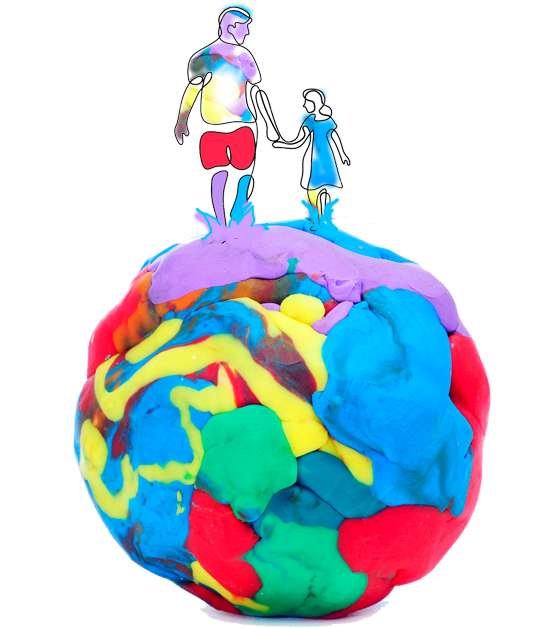
Imagine that the conscious universe is a ball of coloured plasticine with swirls and spirals of different colours. All the colours are experiences but, being a sphere, the universe cannot change or explore itself. To create change in the patterns, it needs to make an outgrowth – something partly separated from the whole. That outgrowth is an individual thing – maybe me or you. By living and relating with others, I twist the clay causing new patterns to appear in the colours. Then, when I die, the projection melts back into the universe and the new colour swirls are incorporated into the patterns of the universe .
Seen from this perspective, I am the universe, condensing into an individual in order to learn or even just to play. Namkhai Norbu, often quoted a Dzogchen saying: “All manifestation is the play of the Dharmakaya”[10]. The dharmakaya can be seen as the primal conscious universe, that separates and becomes individuals as part of its eternal urge to create. This is the deepest meaning of Ming. From the dualistic individual point of view, it is our vocation, but from the universal point of view, Ming is the creative intention of the universe. From this universal point of view there is no dissatisfaction, every manifestation is part of the play of the universe and, through play, it learns.[11].
There is something very expressive about necks. From the gracefulness of a swan’s neck to the powerful neck of a bull. Human necks also have a wide range of differences, from long and slender to strong and condensed, and from the moment I started working with necks in humans, I became aware that I was gaining an insight into the person as a whole.
The state of a person’s neck reveals the relationship between their head and the rest of their body. When there is tension in the neck there is often a conflict between mind and body, a fight between what the mind considers possible and what the body does not. And the mind and the body are often at odds
The neck is vulnerable. It stands alone, somewhat exposed and unsupported by other structures of our skeleton. But this vulnerability could be an advantage. It means that it can be highly flexible and can act as a mediator between the head and the body. If the neck is held tense then it manifests an unsolved conflict between mind and body.
The neck is made up of a number of internal structures. These are: the larynx or voice-box; the major tubes of breathing and digestion, large arteries, veins and nerves (including the popular vagus nerve), and also, but by no means least, the thyroid gland. This quiet, unobtrusive endocrine gland situated above and behind the voice-box, produces hormones that regulate the body’s metabolic rate, growth and development. It plays a role in controlling heart, muscle and digestive function, brain development and bone maintenance. Thus, the neck is home to some very important body parts.
The Neck as a Tree Trunk
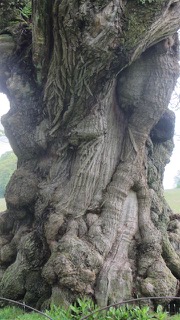
The neck is a bit like a tree trunk, with tube-shaped structures running vertically through it and supporting it from inside. The bodies of the seven cervical vertebrae, the uppermost portion of the spine, provide a strong, stable, central column, along which the tubes of digestion, blood and breathing, run parallel and anteriorly, and these are supported by muscles that allow movement. The deeper muscles run alongside the vertebrae, while the more superficial ones wrap around the tubes’ central edifice. The fascia weaves a continuous web between and around all these structures, lacing them all together. All these are contained within the skin’s most superficial layer, giving us a smooth and sensitive surface to work with.
Our head is connected through the neck to the rest of our body, and is often the part of us which is most visible to the rest of the world. As human beings we are very conscious of our fellow humans. Sometimes we can be overly conscious of how we are ‘seen’ and how we fit in with those around us. Thus, when we are feeling sad or overwhelmed, we can feel the need to put on a “brave face” to the outer world and thus hide our true state in order to avoid disapproval, embarrassment or shame. We can be afraid of “losing face” in some way. In these cases, tension in the face and especially in the jaw, spread into the neck through the connecting muscles and leads inevitably to tension or discomfort in the neck.
The lack of alignment between head and body can manifest in many different ways. People are often led in their movements by their senses, which are mostly situated in the head. Our eyes are probably the most used of our senses because, in general, we are most influenced by what we see. We notice something that catches our attention and interests us, and we are pulled towards it. It can be something that catches our eye in the shops or on the computer screen, or even something we think we need and are looking for. The stimulation from the eyes causes us to move from the eyes and head and the rest of the body is dragged along after. Sometimes the body doesn’t want to be dragged along and digs in its heels. Once again, this conflict between head and body will be felt in the neck. We can also be led in a similar way by our ears and our nose, but we tend to use these senses less than our eyes.
Our actions are led not only by our physical eyes but also by our “mind’s eye”. This can lead to our trying to be something different from our true nature. Again, this attempt to override the objections of the body leads to tensions and stress in the neck. As I said before, the neck is a bridge between the mind and body and is where the gaps in listening can be resolved. The neck tells us when we have a confrontation between our ambitions and our body.
The Neck and Emotions
Another aspect of the neck is its role in vocal expression and its link to our emotions. Our neck houses our larynx, which is built into the upper part of the trachea or windpipe. Our vocal cords (more correctly called folds) are part of the larynx and this is where the sound of our voice is made. This sound-making is closely connected with our self-expression and also our sense of self. Imagine what happens, therefore, when it is unsafe to say something. Or when we might be punished, shamed or embarrassed for speaking out. The muscles around and in the larynx contract and hold, to maintain silence. It can be quite exposing to voice something, especially if it is something challenging to others, and so we protect ourselves by not expressing and by tensing the area at the front of the neck. This, if continued over time, can lead to chronic stiffness in the throat.
A similar thing happens when we express ourselves through singing, which is a louder and even more exposing action. At some stage, many of us have been told that we “can’t sing” and have blocked off this mode of expressing ourselves by holding the muscles tight around the throat.
Expression of any kind is closely connected with emotions and we can feel how these can influence how we hold our neck. The neck is the topmost part of the spine and the spine as a whole is dramatically affected by the emotion of fear. Just as when all the hairs on the back of a cat raise up when it sees a dog, so the muscles along our spine tighten when we feel under threat. Many circumstances can produce this physiological stiffening of the neck. It doesn’t have to be a traumatic life-threatening experience, but can just as easily happen when you are stuck in traffic and are in danger of arriving late for work. If the tension remains even when the danger has passed, the stiffness can become chronic and interfere with other movements, by holding us back.
The Meridians of the Neck
All of the above shows how conflict between mind and body is embodied in structures in the neck that prevent it from flexibly mediating between them. So, helping the neck to move starts a mediation process and facilitates communication between mind and body. Bill Palmer’s research into the relationship between meridians and movement gives us clear tools for exploring the neck. The movements of the neck are strongly related to particular meridians and their function, so helping clients to explore these archetypal meridian movements gives them insight into their internal struggle. This is the main principle of Movement Shiatsu, developed by Bill in the 1980’s: to help a client to use movement to explore their habitual patterns and liberate their energy. I have been practising Movement Shiatsu for many years now and I think it provides the missing link between what the meridians are and how we express ourselves in the world through them.
In the 1980’s and 90’s, Bill worked with babies and made videos of their development. This research convincingly showed that infant movements developed progressively and followed the track of the traditional meridians. This means that meridians can be seen as the pathways along which a baby learns to inhabit and use their bodies.
In addition, babies first learn life skills through movement and then translate those movements into social and psychological capacities. He found that the skills learned through movements corresponded closely to the Qi of the meridian that guided the movement.
For instance, the movement developed along the Large Intestine meridian is a ‘pushing away’ with the arm and turning away with the head. This is first used to push against the ground to lift the head and body off the ground but later it is used to say “No” or “Enough”. This energy of pushing out / pushing away is similar to the traditional function of Large Intestine Qi, which is to expel toxic or unnecessary energy.
Over the 15 years he was doing this research, Bill found that every one of the twelve organ meridians could be explained in this way. He believes, therefore, that working with meridians is intimately connected with reminding people how to inhabit their bodies. Inner Qigong and Movement Shiatsu use these archetypal movements to help people re-embody themselves and to explore how to change habits that have cut themselves off from the innate wisdom of the body.
The neck meridians are all yang meridians and this means that the movements are all proactive, ie the body doing something in the world.
An Example: The Stomach Meridian
One of the earliest of these movements to function in the new-born baby is that of the Stomach function, and the seeking out of nourishment. In the womb, the foetus has been effortlessly provided with all its needs by the mother through the umbilical cord, and after birth the baby has to adjust very quickly to the new need of finding nourishment itself. This reaching for food is very necessary if the baby is to survive and is a strong movement in the new-born. The movement comes from the mouth, which is like a tube reaching towards the source of sustenance. By stimulating the Rooting Reflex, at this time, the baby automatically turns its head and reaches with its mouth towards the side that is being stimulated, in search of the mother’s nipple. This reflex is set into action when the skin beside the mouth is lightly stroked, and this is also the location of one of the points that lies on the Stomach meridian, Stomach 4. Thus, stroking around Stomach 4 stimulates the Stomach function and helping the baby reach with its mouth for nourishment.
The Stomach has other important lessons for the new-born. Through the drawing in of milk by sucking, the jaw, mouth and throat muscles (all parts of the body connecting closely with the upper Stomach meridian) are activated and engaged. And this in turn sets up the swallowing reflex, in the process of which, the baby opens itself up to actually receive the nourishment (ie. milk) into itself. In the act of swallowing the whole of the Stomach meridian is woken up by the resultant toning of the muscles down the length of the Stomach meridian. So, the acts of rooting, sucking and swallowing all involve specific movements in the neck relating to reaching for food nearby, to drawing it in and opening up to receive it.
Most of these reflexes happen in the first year of life; through these, the baby learns a movement and then can make the movement consciously using the same muscles. This change from unconscious reflex to conscious movement is the means by which the infant becomes embodied, and develops from a new-born, making mainly reflexive movements, to a year-old toddler who can stand and walk and express its own individuality.
These movements can be helpful to a client who finds it difficult to seek or receive support from outside. By exploring these movements in a session, the muscular patterns around the existing habit are loosened and the client can open up to being able to ask for and be comfortable with taking in support from others.
Most anatomy is taught intellectually or passively. This means that a person knows where a structure is and can even touch it. But this doesn’t mean that they have an inner sense of that part of their body – they perceive it passively rather than it being an active part of their sense of self.
Experiential Anatomy aims to give you an inner experience of your anatomy. This doesn’t necessarily mean that you can control each part. But it does mean that you can listen to the messages that the organs, bones, muscles and fascia are continually giving. The body becomes a real resource of wisdom, rather than an appendage imperfectly controlled by the mind.
This changes the politics of the self. Most of us in modern first world cultures see the body as something that should do what it’s told. Our decision maker is the conscious mind and we are not taught to listen to the messages that the body contributes unless the sensations are painful. Even in that case, we tend to take pain killers and override the message because the pain is seen as an interruption to the instructions that the mind is giving to the body rather than an important bit of information. If the pain persists, we go to a therapist or a doctor to have it ‘fixed’. We still don’t know how to understand the communication that the body is making through the pain. Politically, this means that our self is an autocracy. The mind is the ruler and the body is told what to do by the mind, which doesn’t take the body into account when making decisions or choosing what to do. If the body is vulnerable it is seen as a failing to be fixed rather than a significant communication.
Experiential Anatomy helps you to listen to the intelligence of the body. Each part of us can be seen as a separate, intelligent, active agent that can contribute to the decision making process like a member of a real democracy. So Experiential Anatomy changes the politics of the self from an autocracy into a democracy. This means that the mind takes the body into account when making choices and learns to move the body in ways that take care of its parts.
Clients most often come to body therapy to fix a painful part of the body, but fixing the problem may not be possible without changing the politics of their self. For instance, if they have a painful knee, it may be possible to relieve the pain through massage. It may even be possible to stop it from re-occurring through exercises that strengthen the muscles that protect the joint. But if the person’s movement habits don’t take the internal messages from the knee into account then eventually the protection will fail and, perhaps as they age, the joint will wear out. Another common example is our attitude to our digestive system. This part of our anatomy has a great deal of intelligence. It knows what we need and sends mood-messages to the brain, which not only tell us we are hungry, but also can tell us what to eat and how to eat.
If we learn to listen to each part of our body then we can become a community of inner intelligences with a combined wisdom far greater than our conscious mind. We call this the Inner Community and it is the foundation stone of Inner Qigong and Movement Shiatsu. Inner Qigong teaches how to use movement and voice explorations to facilitate the Inner Community’s ability to communicate with the conscious mind. Movement Shiatsu does the same but with the help of a practitioner who uses touch and guided movement to deepen the person’s awareness of their body.
We are starting a new term of Inner Qigong classes both online and face to face at the end of September.
And for more information about our online self-study course in Experiential Anatomy or our CPD courses in Movement Shiatsu see https://seed.org/what-courses-do-we-offer/
An interview with Bill Palmer about Physical Democracy, which sees the non-verbal parts of the world, including our own organs, muscles and tissues as being intelligent, autonomous agents which should have equal weight to the mental and verbal aspects of the world. Movement Shiatsu and Inner Qigong show people how to listen to these intelligences and how to form a sense of self that is not dominated by the verbal mind.
Manche Probleme scheinen nicht zu verschwinden, da sie von einem grundlegenden Konflikt innerhalb der Klient*innen herrühren. Die Klient*in steckt in einer Position fest, in der sie mit ihrer wahren Natur kämpft. Die Probleme tauchen oft in Beziehungen, in emotionalen Mustern oder an körperlichen Schwachstellen auf.
In der chinesischen Medizin können diese Probleme als Manifestation von Ming dessen angesehen werden. Dies wird oft als „Schicksal“ übersetzt. Es kann auch als Beschreibung der Agenda unseres Lebens angesehen werden. Anstatt zu versuchen, diese Kernprobleme zu „therapieren“, können wir lernen, sie in Gelegenheiten für die Entwicklung des wahren Selbst zu sehen.
Die drei Meridianfamilien, die die Grundlage von Movement Shiatsu bilden, können praktische Wege dazu aufzeigen. Die vereinte Energie der Familien verwandelt den Zustand der Klient*in von einem Opfer in einen aktive Entdecker*in, die ihr Leben in die Hand nimmt und den eigenen Zustand nutzt, um ihr ganzes Potenzial auszuschöpfen. Anstatt zu versuchen, Probleme zu heilen oder zu beheben, lernen wir, wie wir Schwierigkeiten als Potential sehen können.
Inhalt
Dieser Kurs untersucht:
wie Kernprobleme als Unterbrechungen natürlicher Lebensprozesse angesehen werden können;
wie wir den Körper nutzen können, um die Kernprobleme in Lebenslektionen zu transferieren.
Ziel
Du bist in der Lage:
mit emotionalen Mustern über Bewegung und Berührung arbeiten zu können;
anhand des Gestaltzyklus die verschiedenen Arten von Prozessunterbrechungen zu verstehen;
über die drei Meridian-Familien festgefahrene Prozesse zu identifizieren und zu befreien;
Experimente, Qigong und Erkundungen kennen, welche wir Klient*innen zum Üben für zu Hause mitgeben können.
This course contains articles and videos covering the complete cycle of Inner Qigong.
Inner Qigong focuses on using movement and voice to develop the practitioner’s own experience of their energy functions. These functions maintain the life of the organism and make a connection between physical capacities and mental states. In general, we guide you through a body-exploration, which helps you to feel the state and activity of different organs, muscles, fascia or bones. Then we practice an aspect of Qigong that uses the support of these parts of the body in developing energetic capacities such as “Knowing what you need” or “Creating Clear Boundaries”.
Each of these functions is traditionally related to a meridian and the qigong aims to give you a direct experience of the pathway of these meridians and to explain why they run where they do.
Unlike the live classes, this course is a self-study course and many people find they want to switch to live classes after having tested the water with this course. If this switch is done within one month of enrolment then we are happy to accept the payment for the course as two months subscription to the live classes.
This year, I am trying to open the bodywork we are doing to be accessible to everyone, not just body therapists.
This chimes with my forthcoming book “Physical Democracy” so I thought I’d kick the project off with a blog, followed by a few courses and then the book later this year.
The Schule for Shiatsu Hamburg is hosting three webinars and one three day workshop from November 2026 to May 2027 on this subject. these will be in English but translated to German. See www.seed.org/current-courses
The basic idea – integrating self and other.
– The human brain evolved to socialise so the verbal mind is easily influenced by other people, sometimes even harming ourselves
– The body has its own intelligences which have evolved to care for our wellbeing
– (The Meridian Functions are embodiments of some of these body intelligences)
-The verbal mind often overrules or ignores the body intelligences which causes internal conflict, injury or illness
– the techniques of Physical Democracy help a person to:
a) Listen to the intelligences of the body
b) Find a middle way, including both forms of intelligence
c) Allowing our decisions to be made by all aspects of ourselves
These principles can be taught to everyone using movement processes, simple hands-on techniques, theatre and voicework exercises and the framework of Inner Qigong.
In addition, practitioners of East Asian Therapies can teach clients to balance their lives using the processes of Physical Democracy in a way that integrates well with their treatments . The stages through which people learn Physical Democracy are embodied in the functions of the meridians in the following way.
Step 1: Individuation – learning to feel the body and sense a boundary between self and other.
Meridians involved: Yang Ming (Stomach and Large Intestine) & Tai Yin (Spleen and Lung)
Step 2: Listening to Inner Impulses – learning to discriminate between the motivations from self and from other
Meridians Involved: Tai Yang (Bladder and Small intestine) & Shao Yin (Kidney and Heart)
Step 3: Finding the Middle Way – learning to resolve conflict between self and other and to make decisions with both body and mind.
Meridians Involved: Shao Yang (Gall Bladder and Triple Heater) & Jue Yin (Liver and Pericardium)